
It is not enough to just have a website in today's highly competitive digital world. Businesses need to make sure their websites are visible when potential customers search for products or services online. Two of the most common ways to achieve this are Search Engine Optimization (SEO) and Google Ads.
Both strategies can bring visitors, generate leads, and support business growth, but they work in very different ways. SEO devotes itself to boosting visibility through organic search ranks, whereas Google Ads enables businesses to pay for prominent spots on Google. The best option will be decided by your objectives, budget, industry, competition, and the urgency with which you require outcomes.
What Is SEO?
Search engine optimization is the practice of making a website more visible in Google's organic search results. SEO involves several activities, including keyword research, content creation, technical improvements, on-page optimization, internal linking, local SEO, and building authoritative backlinks.
The primary purpose of SEO is to attract people who are already searching for information, products, or services related to your business.
For example, if you operate a digital marketing agency, you may optimize your website for searches such as “digital marketing services,” “SEO services for small businesses,” or “Google Ads management.” When your pages become visible for relevant queries, they can earn organic traffic without paying for each click.
However, SEO is generally a long-term strategy. Particularly depending on your website, competition, industry, and existing authority, it may take some time to establish strong rankings and traffic.
What Are Google Ads?
Google Ads is Google's paid advertising platform. Businesses can create advertisements that appear when users search for particular keywords or meet specific targeting criteria. Unlike SEO, Google Ads does not require you to wait for organic rankings before receiving visibility. Once an appropriately configured campaign is approved and active, your advertisements can begin appearing for relevant searches.
Google Ads also provides considerable control over campaign settings. Businesses can define budgets, locations, keywords, audiences, devices, ad schedules, and landing pages. This makes paid search particularly useful when a company wants to promote a new product, generate leads quickly, or reach customers searching with strong purchase intent.
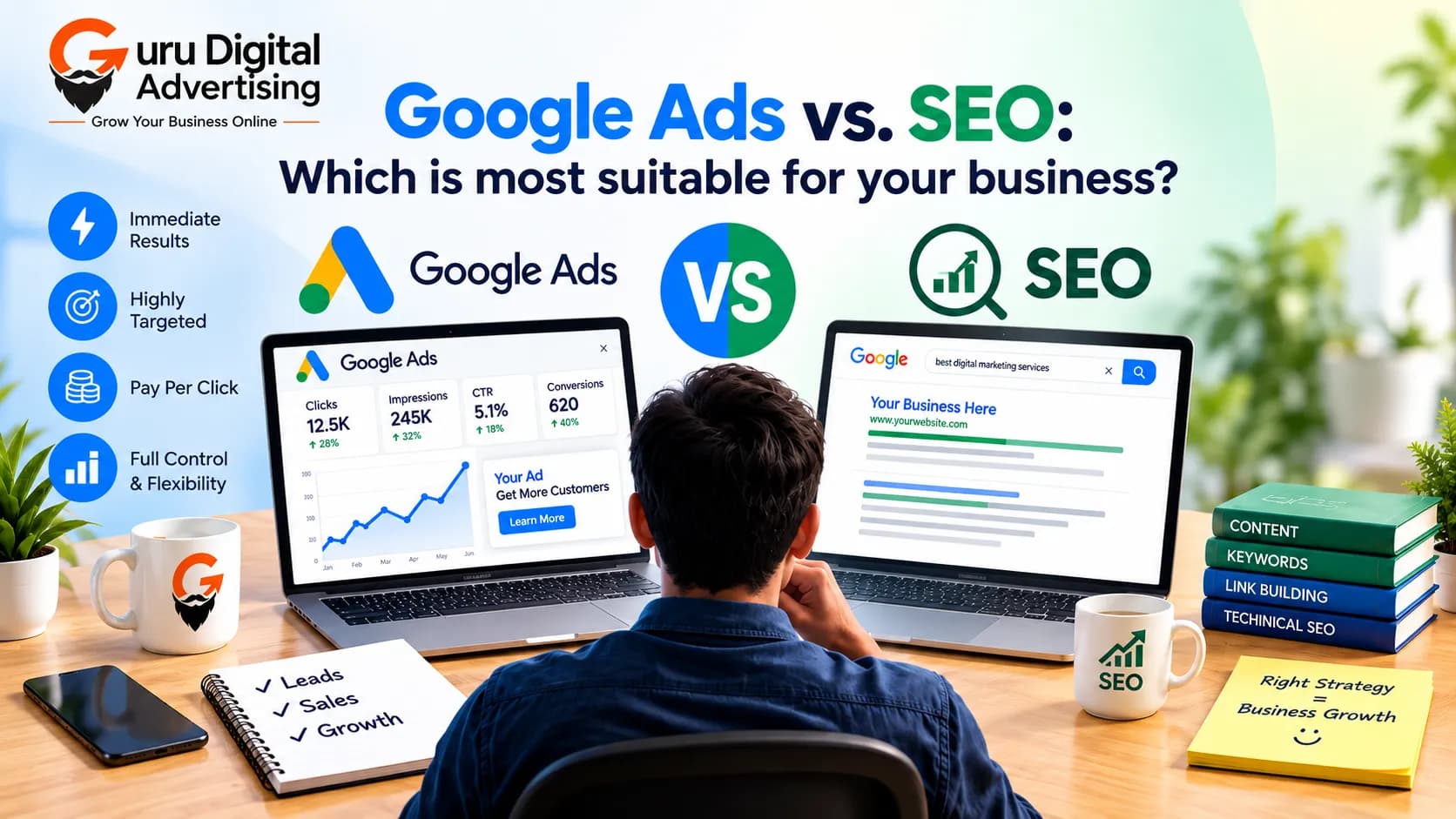
The major difference is simple: SEO earns organic visibility, while Google Ads purchases targeted visibility.
SEO vs Google Ads: Key Differences
Understanding the differences between SEO and Google Ads makes it easier to determine how each fits into your marketing strategy.
| Key Factor | SEO (Organic Search) | Google Ads (Paid Search) |
|---|---|---|
| Traffic Type | Organic & earned search traffic | Paid search traffic (PPC) |
| Speed of Results | Gradual & compounding (3 to 6+ months) | Immediate (As soon as campaign is active) |
| Cost Model | Investment in optimization & content (No cost per click) | Pay-per-click (PPC) model tied to advertising budget |
| Traffic Longevity | Sustainable long-term presence even without ad spend | Stops immediately when campaign is paused or budget ends |
| Audience Targeting | Algorithmically matched by search query and relevance | Granular control: location, time, audience, device |
| Credibility & Trust | High trust from users who favor organic results | Clearly labeled as sponsored ads, high commercial intent |
SEO:
- Generates organic search traffic.
- Requires ongoing optimization.
- Usually takes longer to produce substantial results.
- Builds long-term search visibility.
- Does not charge an amount for each single organic click.
- Can increase website authority and credibility over time.
Google Ads:
- Generates paid search traffic.
- Can provide visibility quickly.
- Requires an advertising budget.
- Allows detailed campaign targeting.
- Provides extensive performance and conversion data.
- Traffic generally decreases when campaigns are paused.
This means the two channels should not necessarily be viewed as direct competitors. They can serve different purposes within the same marketing plan.
Which generates quicker results: SEO or Google Ads?
If speed is the main consideration, Google Ads generally has an advantage. A properly configured campaign can start bringing targeted visitors soon after it becomes active. This can be particularly valuable for businesses running limited-time promotions, launching a new service, entering a competitive market, or needing immediate lead generation.
SEO takes a different approach. Search engines need time to evaluate website content, relevance, technical quality, authority, and other signals before rankings can improve. As a result, SEO requires patience and consistent effort. The trade-off is that successful SEO can continue generating organic traffic after the initial optimization and content work has been completed.
Cost: SEO vs. Google Ads
Cost is another important consideration. With Google Ads, businesses establish an advertising budget and typically pay when users interact with their advertisements, depending on the campaign model. Competitive keywords can become expensive, particularly in industries where multiple companies compete for the same audience.
SEO does not involve paying Google for each organic visitor. However, SEO is not completely free. Businesses may invest in SEO professionals, content writers, technical optimization, website improvements, software, link-building activities, and ongoing strategy.
Therefore, comparing SEO and Google Ads purely on upfront cost can be misleading. Instead, businesses should consider the overall investment, traffic quality, conversion rate, customer value, and long-term return.
When Should You Choose SEO?
SEO is very important when you want to develop long-term online search visibility.
It may make sense for businesses that:
- Want consistent organic traffic.
- Are building a long-term digital presence.
- Publish educational or informational content.
- Want to target multiple relevant search terms.
- Depend heavily on search engine discovery.
- Want to eliminate the long-term dependence on sponsored advertising.
A well-developed SEO strategy can also support brand awareness because customers repeatedly encounter your business while researching solutions.
When Should You Choose Google Ads?
Google Ads can be extremely beneficial when speed, targeting, and rapid visibility are extremely important.
It may be appropriate for businesses that:
- Need leads quickly.
- Are launching a new product or service.
- Want to promote a special offer.
- Need to target specific locations.
- Want greater control over advertising budgets.
- Are testing commercial keywords before investing heavily in SEO.
Paid campaigns can also provide useful search and conversion data that businesses can use to refine their broader marketing strategy.
Why Combining Both SEO and Google Ads Is So Effective
Businesses don't necessarily have to choose between SEO and Google Ads. In many cases, combining both can result in a more balanced search marketing strategy.
Google Ads can provide rapid visibility, although SEO progressively improves organic ranks. For example, a company could use paid advertising to attract customers today while simultaneously creating optimized landing pages and valuable content designed to rank organically in the future.
The data from paid campaigns can also provide insights into which keywords, messages, and offers attract users. These insights can help establish an SEO and content strategy.
SEO or Google Ads: Which Is Right for Your Business?
There is no universal answer to whether SEO or Google Ads is better. The most suitable strategy is determined by your business objectives. If your priority is long-term organic visibility, SEO may be an important part of your marketing plan. If your priority is faster targeted traffic, Google Ads may be more suitable.
Your decision should also consider your competition, target audience, website quality, available budget, customer buying journey, and expected timeline. For many businesses, the most practical approach is to use both channels strategically rather than relying entirely on one. SEO can establish a strong organic foundation, while Google Ads can provide targeted exposure when immediate traffic is required.
Final Thoughts
SEO and Google Ads are powerful digital marketing strategies, but they solve different problems. SEO focuses on building organic visibility and sustainable search traffic, while Google Ads provides businesses with faster access to targeted audiences through paid placements.
Instead of asking which strategy is universally better, businesses should ask which approach—or combination of approaches—matches their current goals, resources, and growth plans.
With the right keyword research, compelling content, optimized landing pages, accurate targeting, and continuous performance analysis, both SEO and Google Ads can contribute to a stronger online presence and a steady flow of potential customers.